
 Log in

The Childhood That Was Taken Chapter III On the Threshold of the Unknown
I thought the world had already shown me what it looks like when it falls apart.
I was nine years old when my father left, and the air inside the house suddenly changed. It did not just get quieter. It became different. It smelled different, it sounded different, even the light was different. As if the walls themselves were standing more carefully. Mom tried to move the same way in the kitchen, to cook the same way, to wash the same way, to tidy the same way, but behind her movements there was something I had never seen in her before. A tired patience. A burden that was too heavy, something you could not set down on the table.
My sister was still little, and the world protected her by instinct. A child always has shelter in adults’ eyes. For me, it was not that simple anymore. I already understood that something was not right, I just did not understand who would tell me when it would be right again.
I heard Mom at night a lot. Not loudly. Not the way it was during a fight. More like the way a person talks to themselves when they think nobody can hear. Sometimes I could tell she was awake just from her sighs. Sometimes from a small sound coming from the kitchen, as if a mug had moved, or a chair had creaked.
At times like that, I listened under the blanket.
I was not afraid the way you get afraid when there is shouting. This was different. This kind of uncertainty does not hit you, does not shove you aside, does not yell. It just slowly crawls into your chest and stays there, like a cold hand.
Then one day I noticed Mom was trying.
Not for us. For herself.
She brushed her hair differently. Not always, just sometimes. She put on her coat differently, as if in the mirror she was not only looking at her face, but at the question behind it too. Can I still be someone. Can I still start something.
She did not say anything.
Just one afternoon, when we got home, there was a strange scent in the house. Not strong, not pushy. But it was male. Shoe polish. Cigarettes. Cold air on a coat. Something that did not belong to us.
I stood on the threshold, and I heard his voice.
It was deep, confident. Like someone who was used to being listened to. Mom laughed at something. Not the way she usually laughed with us. Different. A little higher, a little faster, as if she wanted to show she could be light too.
My sister was already running inside, the way little ones do. I did not go right away.
I stayed on the threshold, and I felt that something was beginning. Something I did not know yet. And just because I did not know it, that did not automatically make it bad. But my stomach still tightened. Because the past had already taught me that what comes next rarely asks me.
Mom finally noticed me then.
She looked at me, and there was a moment when she seemed frightened of her own decision. Then she smiled and said, come here, I will introduce you.
The man turned toward me.
And in that second I understood that the unknown is not out in space, not far away, not in some big adventure.
The unknown is standing in our living room.
My sister was already running inside, the way little ones do. I did not go right away.
I was nine years old, and I already understood too much of what a child should not have to understand yet. I knew that adults’ smiles are sometimes not joy, just effort. I knew that silence can be louder than shouting. And I also knew that if a stranger steps into the house, it is not only him who comes in, but a new set of rules too.
I stayed on the threshold.
From the living room I could hear his voice. It was deep, a little too confident. Not the kind of male voice that asks, but the kind that declares. Mom laughed at something. Not the way she usually did with us, but the way a person laughs when they want to make a good impression. That laugh felt strange to me. As if I was not hearing my mother, but someone trying to be her.
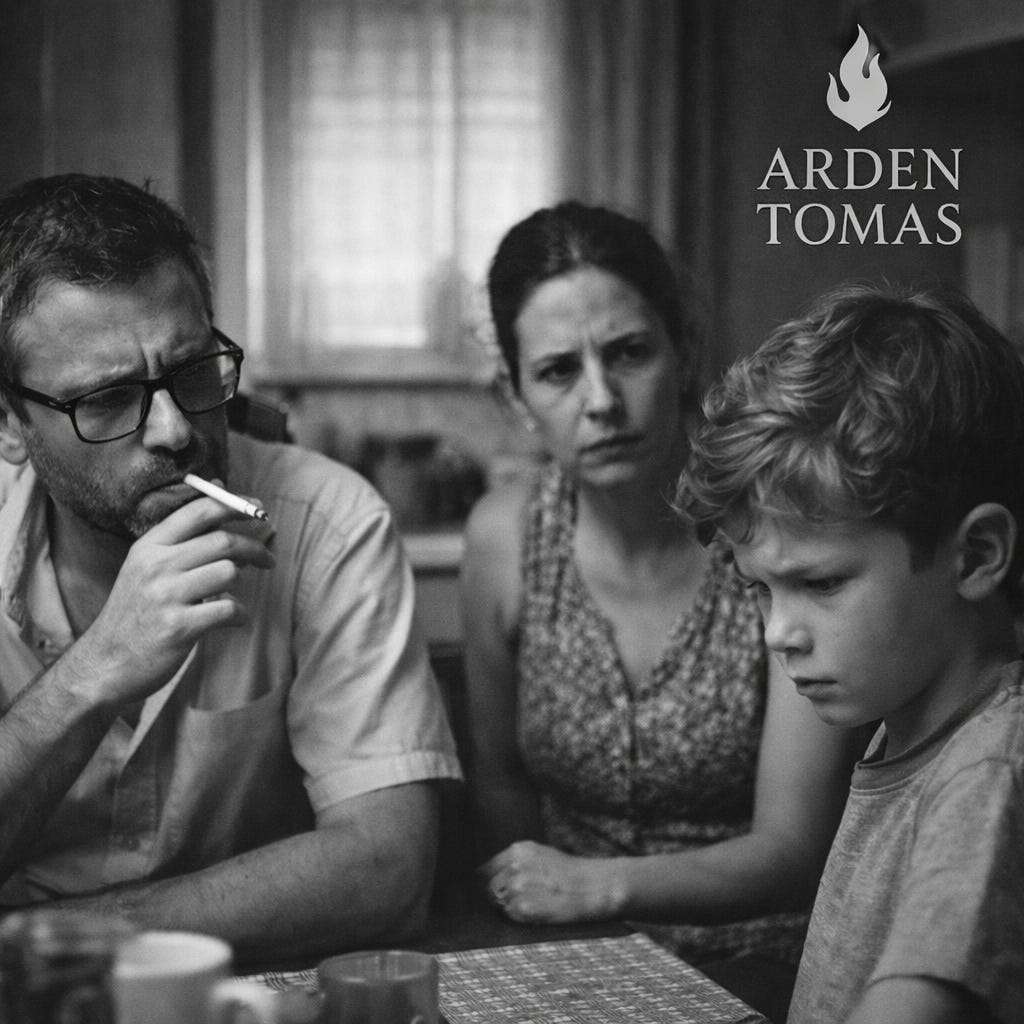
In the air there was that strange scent. A man’s smell. A coat, cold outside air, something metallic, something smoky. It was as if our house, for a moment, had lost its own smell and made room for someone else’s.
Mom finally looked at me.
For a single moment I saw something on her that I rarely saw back then: uncertainty. As if she both wanted me to be proud of her and was also afraid I would get scared. Then she smoothed herself the way she always did. She smiled and motioned.
Come on, Tomi. I will introduce you.
I stepped inside.
The man stood in the middle of the room. He was not especially tall, but he filled the space as if he deserved more of it than anyone else. His gaze ran over me. Not cruelly, not kindly either. More like the way a person sizes something up.
His hand reached toward me.
Hello, he said. His voice was too calm. You are the boy.
The boy.
Not my name. Not Tomi. Just “the boy.”
I took his hand because that is what you do. His palm was dry, strong. His grip was brief, certain. Like a seal. Like a declaration that he was here now.
Mom stood beside us, watching my face. Waiting to see what I would do. Whether I would smile. Whether I would be polite. I felt in her that silent request that I could not put into words yet, I only felt its weight.
Be good. Be nice. Do not ruin anything.
Meanwhile my sister was already talking. She was lighter. She did not see the patterns yet. She still believed that what is new can only be exciting.
I did not believe it.
I still did not know why, I only knew my stomach tightened and my shoulders tensed on their own, as if my body knew before my mind did.
The man smiled.
Not wide. Not warm. More like he had decided something.
Well, he said, we will see.
I do not know what exactly he meant by that.
I only remember that in that moment, at nine years old, there in the middle of our living room, I felt it for the first time:
The unknown does not ask.
The unknown arrives.
Back then, I was still happy.
I was happy that Mom was laughing. That someone brought lightness back into her. After the divorce the house was often like the air itself moved carefully, as if you were not allowed to be too loudly happy. And now suddenly there was someone because of whom Mom could be a woman again, not only a mother. At nine years old I could not have said it like that yet, I only felt it was easier to look at her.
I had to call him Uncle Zoli.
The word uncle meant something distant. An adult. Authority. Someone you have to adjust yourself to. And I adjusted. I was polite. I tried to behave the way a good kid should around a suitor. Because I thought if Mom was happy, then it would be better for us too.
Only there was something strange.
Uncle Zoli paid attention to my sister.
Not sometimes. Not just calling to the kid. But really. He picked her up, rocked her, clowning around for her, asking her questions, even when she only whined or threw a tantrum, he still focused on her. My sister’s voice filled the room, and Uncle Zoli seemed tuned to it. Like that was what mattered.
And I was there beside them, in the background.
I tried to join in. With a question, a sentence, by bringing over one of my toys. But somehow it always turned out that attention slid back to my sister. As if I was not interesting. As if I was already finished, checked off. And my sister was fresh, loud, lively.
And that hurt.
Not in a way that made me cry. More like each time Uncle Zoli turned toward my sister, something in me stepped back a little. I stayed quiet. Nobody asked me. There was no question meant for me. I only stood there, trying to believe I was part of what was happening.
Mom noticed I was there too, sometimes she smiled at me.
But those smiles were quick. The kind that says, be patient, in a minute, just right now something else is going on. Only right now was always around my sister.
Mom and he went out a lot to have fun.
I knew because I heard them getting ready. The rustle of clothes. The tap of shoes. The smell of perfume that rarely filled the apartment back then. Mom was excited. Sometimes she even hummed. And I felt happy for her and also had a bad feeling, as if the price of her happiness was that I ended up at the end of the line again.
Uncle Zoli came to our place every day.
His presence almost became normal, and Mom grew more cheerful. I also became more cheerful because a child always hopes. A child always thinks now it will be good. Now we have arrived somewhere safer.
Only that bad feeling did not go away.
It sat inside me like a small pebble in a shoe. Not a big deal. But you feel it with every step.
Grandma and my godfather saw it.
They did not say it out loud. They did not stop it. They did not make a scene. They only looked the way adults look when they sense something but do not know what they can do because on one side there is suspicion and on the other side there is Mom’s happiness.
Mom was happy. Maybe in love.
Even I could see that.
Then Uncle Zoli traveled back to East Germany.
They said he worked there. The word East Germany was a far, foggy world to me then, something we had nothing to do with. I only understood that he left. And that from now on letters would come.
Mom wrote letters to him.
I saw the envelopes. The handwriting. The motion of Mom carefully opening them, as if something fragile lived inside the paper. Sometimes she smiled while reading. Sometimes she went quiet. Around those letters, Mom somehow felt more like Mom again and less like the person she became after the divorce.
In a year he would come home for good.
That is what they said. As a promise. As a plan. As if time would be in order from then on because there was a date you could wait for.
And once, in a letter, he asked what he should bring for my sister and for me.
That question carried more weight than it looked like. Because it was not only about a gift. It was about whether he thought of me. Whether I mattered. Whether he noticed me.
My sister asked for a talking, crying doll.
Of course she did. That fit her. She was the little one. She was the one who always had some loud wish.
I asked for a portable quartz game.
I remember even saying that word felt like asking for a secret treasure. I knew it was a big deal at the time. Because in socialist Hungary you could not buy it. Not like dolls. Not like ordinary toys. This was something else, something rarer, something special.
And as I said it, somewhere deep down I also hoped that if I got it, it would mean that he saw me too.
Not only my sister.
Not only the little one.
But me too.
Back then the weekends had one steady point.
My godfather.
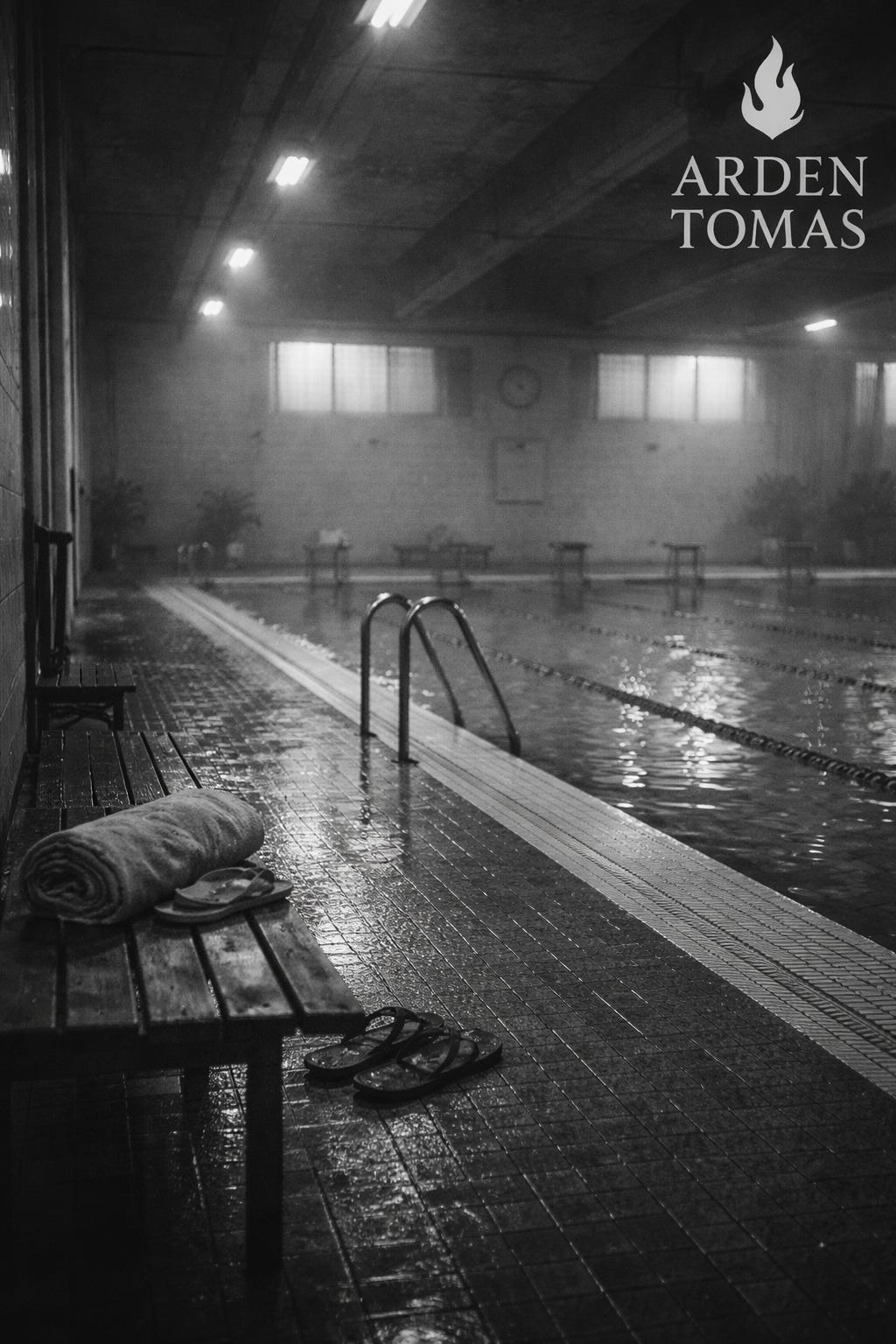
Every weekend he took me to the swimming pool in the neighboring city, Kecskemét. For me it was not only a program, it was an escape too from the thickness of weekdays. A time when someone was truly with me. Not only next to me, but with me.
He taught me how to swim.
Not impatiently. Not in a way where his mind is somewhere else. But in a way where he paid attention to me. He showed me how to breathe, how to hold my body, how to trust the water. And I learned quickly. As if my body had been waiting for exactly this. To finally be good at something, and to have someone notice it.
I enjoyed it.
I looked forward to those weekends because the pool was its own world. The huge indoor basin, the echoing space, the smell of chlorine, the sound of splashes. Everything was clean and simple. In the water you did not have to be smart, you did not have to behave correctly, you did not have to figure out what an adult feels. You only had to swim.
After swimming I always got hungry.
And my godfather always did the same thing. He bought me a hot sandwich. Simple, warm, comforting food, and in a strange way it also meant safety. That it mattered that I was hungry. That he took care of me.
Then we went to shower.
At first the world of the communal showers was only noise and steam. Faucets, slippery tiles, voices from everywhere. Many men, many movements, everyday naturalness, the way they stood there, talked, toweled off.
And I just watched.
I still did not know what my eyes were looking for, I only knew that sometimes something stopped inside me. As if my mind went quiet for a moment. It was not fear. Not shame. More like a strange, unexplainable feeling that I could not place.
I did not understand what it was.
Only that it felt good, and at the same time it unsettled me a little, because I had no word for it. I did not tell anyone. I could not have. At nine, you do not explain. You only collect. Memories, impressions, small secrets in your body.
And somewhere there, between the steam and the running water, very softly, almost unnoticed, something began inside me.
Not as a big thing.
Only as a sign.
Uncle Zoli came home.
The news had been floating in the air for days, and when they finally said it, something in me loosened. As if all those letters, all that waiting, suddenly took on a body and was no longer only a promise but real. Mom was cheerful, my sister was excited, and I was happy too because I thought this homecoming might mean everything would fall into place.
That I would finally be part of the picture too.
The packages were there.
The moment gifts come out is always a celebration for a child. The rustle of paper, the boxes, the anticipation, the quick beating of the heart. My sister was practically bouncing, and I tried to look calm because I felt like I should by then. But inside I was trembling too.
My sister got the doll she wanted.
A talking, crying doll. Exactly what she asked for. When she saw it, she squealed with joy, and Uncle Zoli laughed. Mom smiled. The room filled with excitement, and everyone moved around my sister, the air sparkled around her.
Then he looked at me.
And he handed me a stuffed dog.
A stuffed dog.
My hand took it automatically because that is what you do. I thanked him because that is what you do. But something in my chest sank. Not slowly. In one motion. As if someone pulled out from under me the thought that he saw me too.
The stuffed animal was soft, completely harmless.
Still it felt like a slap.
I almost cried.
Not because it was a stuffed dog. But because I suddenly understood that my request did not matter. My desire did not matter. I did not matter the way my sister did.
I opened my mouth, and before I could stop myself, I asked:
Was there not a quartz game?
And then what happened was the thing that made the room freeze all at once.
Uncle Zoli snapped at me.
Not the way someone explains. Not the way someone understands. The way someone orders you back into place.
Be glad you got anything. Do not be so greedy.
His voice was sharp, and each word cracked like I was at fault for hoping. Then the other sentences came too, fast, from anger, as if I needed to be put in my place.
There was no western brand. Only eastern. I did not have time to exchange money. How can you be so demanding?
I only stood there with the stuffed animal in my hands, and I felt that something had slid badly out of place.
I did not understand.

And before I could say anything, I got the final stamp.
Do not be a crybaby. I will make a man out of you.
The sentence stayed in me like a cold object.
Not only because of what it meant. But because I felt in it that he did not see me as a child. Not as someone who has feelings. But as something that must be shaped. Fixed. Remade.
The worst part was that Mom did not step in.
She stood there. She heard it. She saw my face. She saw that I was about to cry.
And she did not say anything.
As if it was fine.
As if I had asked for too much.
What is happening. What did I do wrong?
I did not understand.
I only felt that I was disappearing again. That I was stepping back. That I was staying quiet because my voice only makes trouble.
And the stuffed dog was there in my hands.
It was soft.
But in that moment, I began to harden.
Then they sent us to camp.
My sister and me. To Lake Balaton, to the Pioneer camp, for ten days. Ten days is a lot for a child. Long enough to feel both free and abandoned at the same time. In camp everything was planned. Lineups, meals, group programs, loud laughter, discipline, flags, songs. The smell of Balaton, the warmth of the sun, wet towels, dusty feet.
And in the middle of it there was a strange calm inside me.
Because Uncle Zoli was not there.
I did not have to watch him. I did not have to figure out when he was in a good mood, when he would look at me like he was searching for a mistake. At camp the world was simple. The rules were dumb, but predictable.
Mom wrote letters.
Holding an envelope with my name on it always felt strange. As if the paper carried her voice. As if behind the ink there was the old Mom, the one I could still sometimes imagine, like before: only ours.
In the first letters there was good news.
Mom wrote that by the time we got home, Uncle Zoli would renovate the house. There would be central heat. The outside would be painted. There would be gas. The sentences lined up like a future that would be more comfortable. Warmer. More stable.
I was glad about that.
Central heat back then was not just heat. It was a big promise. That you would not have to be cold anymore. That you would not have to live the way we did before. That someone would make right what was half finished.
But there was another feeling too.
The one I was not glad about.
That Uncle Zoli would move in.
Mom did not write it at first, but I felt it behind the lines. Because renovation is not only work. It is claiming territory. It means someone is no longer a guest.
Then I reached the second part of the letter.
And there was that sentence.
Mom wrote that Uncle Zoli would be our new dad.
Not as maybe. Not as we will see. It was a statement. A decision. A done fact.
And I sat on the camp bed with the letter in my hand, and suddenly I felt the same tightening I felt when the stuffed dog was put in my hand.
As if the ground had been pulled out from under me again.
My sister was happy.
She did not grasp what it meant. Or if she did, for her it meant: there will be a man who is here, who brings things, who is strong, who does something. Little ones often rejoice at what we already fear.
I was not happy.
I could not explain exactly why, I only felt that there was not celebration inside me but alarm. Because “new dad” did not just mean words, it meant power. Rules. A voice in the house. Doors slamming. A look that makes you shrink.
And I also felt that this was not my decision.
Nobody asked me.
Nobody asked whether I wanted it. Whether I was afraid. Whether I liked this man.
They just wrote it down.
Like a plan.
Like a reconstruction.
And there, by Lake Balaton in the Pioneer camp, cut off from home for ten days, I suddenly understood something that made the letter feel heavy in my hand:
By the time I go home, I am not going back to the same house.
After camp, it was not the same house waiting.
The air was the same, the walls stood in the same place, but something had changed in the order of things. As if the space had a new owner. Uncle Zoli was no longer a guest but a rule. No longer a question but a statement.
And the worst part was that everyone took it as natural.
It did not take long before what he called education began.
I will make a man out of you.
He said it like it was a great gift. Like I should be grateful he was even dealing with me. And at nine I understood only this: what I was was not enough. Wrong. In need of fixing.
His garden was big.
It was not our garden, it was his. That is how he spoke about it too. Mine. My land. My order. And in the summer the garden was not play, it was work. Work that made my stomach clench in the morning because I knew I would be standing between the rows again, in sun, dust, sweat, and he would be watching again.
Not helping. Watching.
I hoed. I watered. I picked fruit.
Every day.
It was as if the whole summer was one long, hot day that never ended. My hands stank of dirt. There was always a dark line under my nails. My shirt stuck to my back. My legs turned to lead, my head buzzed, and when I finally got home, I did not feel relief.
I only felt tired.
My sister did not have to.
She sometimes hovered around, sometimes brought a glass of water, sometimes played with dolls on the steps, but there was not that look on her, work. Nobody yelled at her to go faster. Nobody told her she was clumsy. Nobody told her she was worthless.
Mom worked there a lot too.
I do not forget that. Mom also hoed, watered, did what had to be done. And that often made it even harder. Because Mom was there, nearby, and I thought if she was there, she would protect me.
But she did not protect me.
Uncle Zoli did not really work.
He assigned the work. With his voice, his gaze, the confident motion with which he shoved a tool into my hand.
Hold it right. Not like an idiot.
If I did something wrong, the scolding came.
Not once. Not rarely. Always.
If I did not hold the tool the way he wanted, he called me awkward and stupid. Those words burned into me. Because he did not say, do it differently, he said, this is what you are.
Awkward. Stupid.
And he yelled.
His yelling had its own tone. Not only loud, but contemptuous. As if he enjoyed towering over me. As if by humiliating me, he became bigger.
I remember once the hoe slipped in my hands.
Not a big deal. A tool is heavy for a child. The soil is hard. The sun burns. But he reacted as if it was a crime.
What is this. Why are you holding it like that. Why are you so stupid.
My heart beat so fast I could barely breathe. I tried again. I tried to do it right. And I felt that it was not the hoeing that was at stake.
It was me.
That I was being tested again. That I had to prove again that I had the right to be in my own home.
Then his friends came.
That is where it truly started to hurt.
Because when strangers came, when they were there in the garden or in the kitchen, when they drank and got loud, Uncle Zoli turned it up even more. As if he needed an audience. As if his manhood was strengthened by showing them how much he controlled me.
Well, look what this kid is doing.
And they laughed.
Or they stayed silent. But that silence was laughter too.
That was when Uncle Zoli said the harshest things.
That I would not even be a laborer because I was so useless. That I would be a worthless man. That if I kept going like this I would amount to nothing. That I was a crybaby.
And I stood there in my dusty shoes, sweaty, exhausted, and I did not know where to look.
Because if I looked at them, I felt ashamed.
If I looked at the ground, he said, do not stare at the ground.
If I looked at Mom, she turned her eyes away.
And that was the hardest part.
I complained to Mom.
Not once. Many times. Whispering. At night. Just us. When I thought now she will be Mom. Now she will understand. Now she will say, enough.
And Mom said that Uncle Zoli wanted what was best for me.
He wants what is best.
As if humiliation were good.
As if yelling were education.
As if my pain were just being too sensitive.
And then something in me stepped back again.
I disappeared.
I became unnecessary.
I stayed quiet.
Nobody asked me.
And the summer kept going, hot, exhausting, with the same sentence hanging in the air that he threw at me again and again like a piece of rock:
I will make a man out of you.
For a long time I thought it was “just” bad.
That Uncle Zoli was like that. That he was loud. That he was strict. That that was his nature. That I would get used to it because everyone said so. Mom said so too. Adults always find words for why a child should endure what they should not have to endure.
But there was a day when it tipped.
When I no longer felt only that he humiliated me.
But that I was afraid of him.
I remember the garden. The sun was lower, but it still burned. The air was dusty, sweat stung my eyes. My hands ached from the tool, my fingers held on in a cramp because if I loosened, he would snap again.
The hoe caught.
In a root, or a hard clod, I do not know. I only know the motion broke, and the tool yanked my arm. It was not a big mistake. Not something anyone would yell about. It was a child’s mistake.
But he did not see it that way.
He stepped up so close that I smelled alcohol on his breath. He did not always drink, but when he did, that smell was the signal: this will not be good.
His voice did not only get loud.
It changed.
Quieter, deeper, more threatening. Like when someone is not trying to explain but to dominate.
Look at me.
What are you doing, you idiot.
My stomach clenched. I felt my throat tighten, like there was not room for air. My body became smaller automatically. My shoulders caved, I lowered my head because I felt if I did not look at him, maybe he would not find me.
But he wanted me there.
All the way.
His hand lifted. He did not hit me.
But the motion was enough.
That half second when you do not know what comes next. When the body has already started fear because the mind does not have time yet.
I flinched.
And he noticed.
He smiled.
Not kindly. Not jokingly. Like he was pleased it worked on me.
See. That is how you make a man.
And then I understood this was not education.
This was pleasure.
It was not the garden that mattered. Not the work. Not whether I hoed correctly.
It was that I stood there before him, broken small.
On the way home I did not speak anymore.
My legs carried my body, my head was empty, only one thought circled inside it like a bad song.
Mom will stop it.
Mom will notice.
Mom will stand between us.
At home Mom was in the kitchen. Doing something, maybe dinner, maybe just putting things away. My sister bustled around her. The whole picture looked like a normal family, and that made it worse.
Because I was outside of it.
I stopped in the kitchen doorway.
Mom looked at me, and for a moment she seemed to see something was not right. But then the motion continued, the routine, the day.
And I could not say it nicely.
I could not say it smart. I could not say it like an adult.
It just spilled out of me.
Mom, please, do not let him yell at me all the time.
Mom, I do not want to be with him in the garden.
Mom, I am afraid.
I did not say it exactly like that back then, because at nine you rarely say, I am afraid. You only say, I do not want to. That it is bad. That he should stop.
Mom looked at me.
And instead of standing between us, she said:
Uncle Zoli wants what is best for you.
He is only raising you.
You are too sensitive.
You will get used to it.
That was the moment.
Not the yelling.
Not the humiliation.
But this.
When I understood it did not matter that I said it.
It did not matter that I asked.
It did not matter that it hurt.
Mom would not stand between us.
Not because she did not love me.
But because she was weak.
Because she was afraid.
Because it was easier for her to believe Uncle Zoli was good than to face the fact that I was being hurt.
And then something in me closed, very quietly.
I did not cry. I did not scream. I did not beg anymore.
I just stepped back again.
I stayed quiet.
And the next morning I went out to the garden like someone who knows:
Here, I am alone.
Uncle Zoli was at the factory. Mom was at the hospital. My sister was at Grandma’s.
The house was rarely this quiet. It was a kind of quiet that did not calm me, it made the air suspicious. As if the walls were watching what I did. As if silence had a price and I did not know how much yet.
I did what Uncle Zoli assigned.
I had to clean the pigsties. The smell sank into my clothes, into my skin, into my hair. No matter how I washed my hands, no matter how I scrubbed, it was as if the whole day stuck to me. After the work my arms were heavy, my back ached, and still there was a strange relief in me.
Done.
Now at least for a while he cannot find fault.
I finally had free time. A rare phrase back then. Almost foreign. Something I did not dare say out loud, in case someone took it away.
The door to their room was slightly open.
I do not know why I went in. Or rather I do know, only I did not want to admit it then. Prohibition is always a magnet. Curiosity is always stronger when you are also afraid.
In Mom’s and his room, the smell was different. Cleaner. Perfume. Proper. Like an adult world I did not have a pass into. I moved slowly, carefully, as if I feared the floor itself would tell on me.
Then I saw them.
German magazines. The kind you could not just see around here. The paper was glossy, the photos too sharp, too real. My heart sped up just from holding them.
I opened one.
At first I only looked. Page after page. As if it was not me. As if someone else’s hands were turning the pages for me. There were naked bodies in the photos. Women too, but I caught myself searching for the men.
Not consciously. By instinct.
There was something in the male bodies that made my breath catch. Muscles. Hair. Shoulders. Arms. A kind of confident posture I never felt in myself. As if those men did not even come from the same world where I was called awkward and stupid.
I thought I should feel ashamed.
But I did not.
It felt good.
So good that it scared me.
My body reacted before my mind could explain why. My chest tightened, my skin became more sensitive, as if every nerve ending in me woke up all at once. I sat in that room with the German letters I did not understand, and yet I understood everything the pictures were saying.
I also felt I had to keep this secret.
That if someone walked in now, there would be trouble. They would not only scold me. They would not only take the magazine away. Something much worse would happen. Something my stomach already sensed exactly.
Still I kept looking.
And meanwhile another desire was born in me. Not only to look at them. But to be like them.
So muscular. So hairy. So masculine.
Not to satisfy anyone. But because then maybe no one could look at me like I was a flaw.
And there, in that strange, stolen afternoon, another thought came to me too, and it made me stronger and more ashamed at the same time.
That if I ever became strong, I would pay it back.
Not with violence. Not the way he hurt me.
But by no longer being afraid of him.
By one day looking him in the eye and not shrinking.
By one day not letting him be the one who decides who I am.
The pages rustled softly under my hands. The house’s silence was thick around me. My heart was beating fast, and at the same time some unknown, hot, deeply personal feeling spread through me.
As if a door had opened a crack.
And I did not know yet that later, through that door, how much joy and how much pain would come in.
I only knew that what was terror outside in the garden was something else entirely here inside, in secret.
Something that was mine.
That day nothing obvious happened.
No one came home early. No door flew open. There was no scandal. No getting caught. The house stood the same way, the silence sealed itself again, as if nothing had happened.
And still, something in me had changed.
I put the magazines back exactly where I found them. As if I had never touched them. As if my hands had not been trembling. As if my heart had not been beating too fast.
Then I went into the kitchen, drank a glass of water, and tried to take my face back.
My child face.
The one who only cleaned the pigsties.
The one who only got free time.
The one who only did nothing.
But my body did not forget.
My skin remembered that feeling, that strange, pleasant buzzing, that forbidden warmth that was desire and escape at the same time. And my mind remembered the thought that was born there among pages, in silence:
that one day I will be strong
that one day I will not be afraid
that one day he will not be the one who decides who I am
In the evening, when they got home, everything went on as usual.
Uncle Zoli’s voice filled the house. Mom was tired. My sister talked, laughed, told something. The everyday life acted as if it was the one in control.
And I sat there among them, knowing that now there was something inside me they could not see.
A secret.
Not because it was a sin.
But because it was dangerous.
Because once it is spoken, you cannot put it back in its place.
That night, before I fell asleep, my eyes stayed open in the dark for a long time. The sounds of the house slowly faded, and my thoughts circled inside me like a new, unknown constellation.
I still did not understand exactly what this was.
But I felt that the unknown was already here. Not outside in the world, not somewhere far away, but inside me.
And I knew that in the next chapter, it would not only be terror that continues.
But also what I am, quietly, becoming.