

 Log in

The Childhood That Was Taken
My True Story
Preface
Dear Reader,
This book is my true story. It is not a novel, not fiction, not an invented life. It is built from my memories, from the way I experienced everything that happened to me, beginning in early childhood.
I tell the story of a childhood that may have looked ordinary from the outside, but slowly began to crack from within. There were moments when I did not yet have words for what was wrong, only the feeling that something had shifted. The signs were small. Glances. Sentences. Silences. Movements that were barely understandable at the time, yet later illuminated everything.
I will tell how my carefree childhood came to an end. How safety turned into questions, questions into fear, and fear into silence. This is also the story of becoming aware of myself. The path toward realizing that I was different from what was expected of me. Not better. Not worse. Just different.
There will be talk of denial, because there was denial. Of hiding, because I needed it. Of lies, because that was how I survived. And there will be the recognition that eventually became unavoidable. The moment when I could no longer keep running from reality. When it became clear to me, even without words, that I was gay.
This book is not meant as an accusation, nor as an explanation. It is a testimony. The voice of a person who was silent for a long time, and who now speaks what can be said, and what must be said. Exactly as he remembers it.
If you choose to walk with me, you will be reading a true story. Not always an easy one. Not always a gentle one. But an honest one. And if, even for a single moment, you feel that you are not alone, then this book has already fulfilled its purpose.
Section 1
I have memories starting from the age of three. They are not clear images, but sensations. Moods. The certainty that something was there, even if I did not yet have words for it.
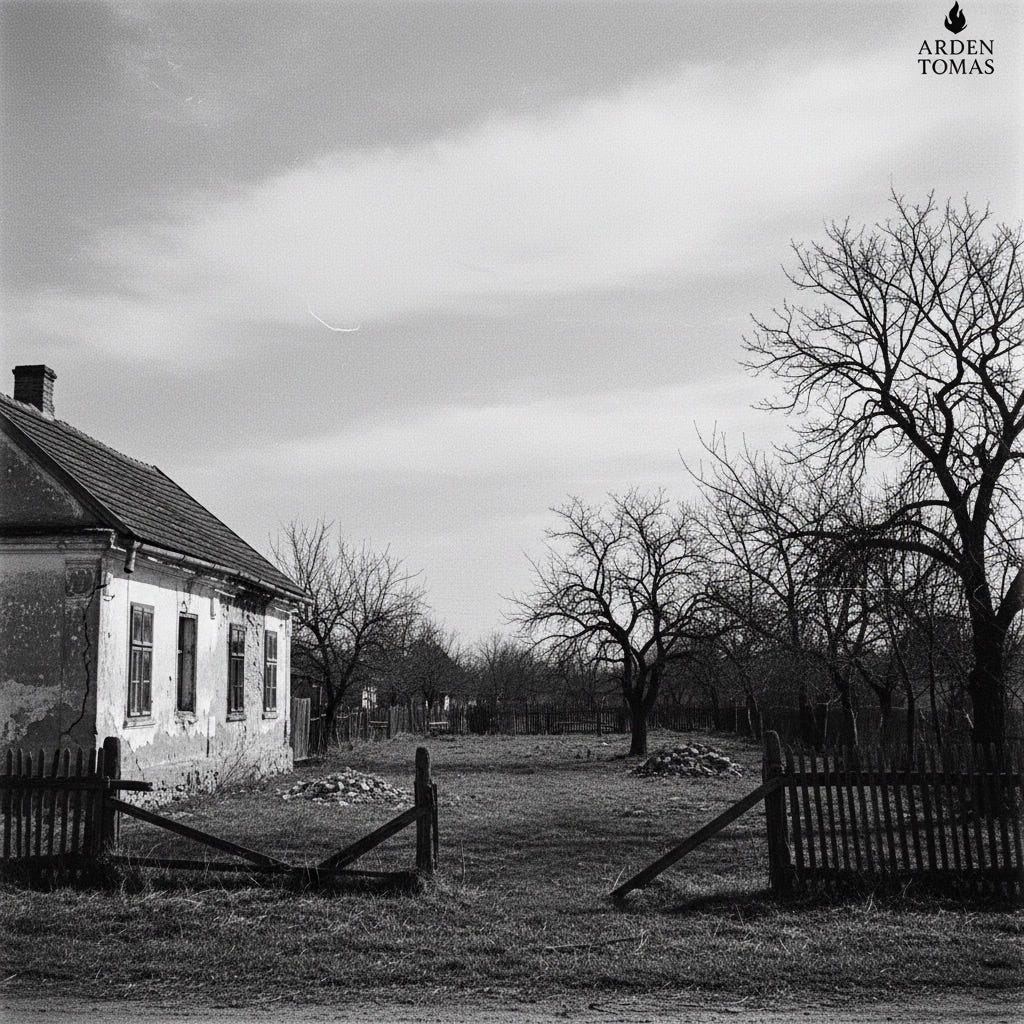
At that time, my life could still be called ordinary. My mother and father were living together, in what seemed like a happy marriage. There were no constant arguments, no fear. There was a family that, then, still appeared whole. We lived in my father’s grandmother’s house. It was practical to do so. Our own house was being built, but it was not finished yet.
Hungary was still deep in the communist era. Life was regulated, paths were decided in advance, expectations set from above. My father was completing his mandatory military service. My mother was pregnant with my younger sister. She was a young woman living in someone else’s house, under the same roof as an elderly woman she could never truly connect with.
My great grandmother did not like children. She was not loudly cruel. She did not shout. She was cold. Distant. One of those people whose presence creates tension without a single word being spoken.
I was a good child. Quiet. Compliant. I watched the adults closely and tried to behave the way I thought I should. One day, I went up to her and asked her to play with me. I do not remember exactly what I said. I only remember wanting her attention.
She did not respond. She heard me and chose not to answer. I asked again. Louder this time. Not out of defiance, but out of desperation. A child does not understand indifference. He only feels himself disappearing.
When she finally grew tired of my voice, she slapped my hand and scolded me for being badly raised. I did not understand what had happened. I only knew it hurt. Not so much my hand, but everything else. No one had ever hurt me before. I was a good child.
I cried. Loudly. Uncontrollably. Not from the pain, but from the injustice. From being rejected and punished by someone I had turned to.
My mother fought with her fiercely over it. She defended me. There was shouting, anger I had never witnessed before. That moment carved itself into me. Not because I was afraid, but because it was the first time I understood that the adult world was not safe. That there was injustice, and that sometimes it could only be met with raised voices.
This was my first memory of the world not being kind. And perhaps the first crack inside me, long before I had any understanding of who I was or who I would become.
Section 2
When my father came home on leave from the army, it was considered a special occasion. My mother told him about what had happened with his grandmother. She told him that she had hit me. She expected him to protect me. To stand up for me.
He did not make a big deal out of it. His reaction was brief and final. He said I must have deserved it. That I should not be spoiled. That was all. There was no anger, no outrage. The matter was closed. At the time, I did not yet have the language for it, but looking back, this was the first moment I felt that paternal protection was not something I could depend on.
My father was almost a child himself. He was twenty years old when I was born. My mother was twenty one. They were young, inexperienced, pushed too early into adult roles in a time that rarely allowed room for reflection. My father began drinking beer, and as he drank, his mood improved.
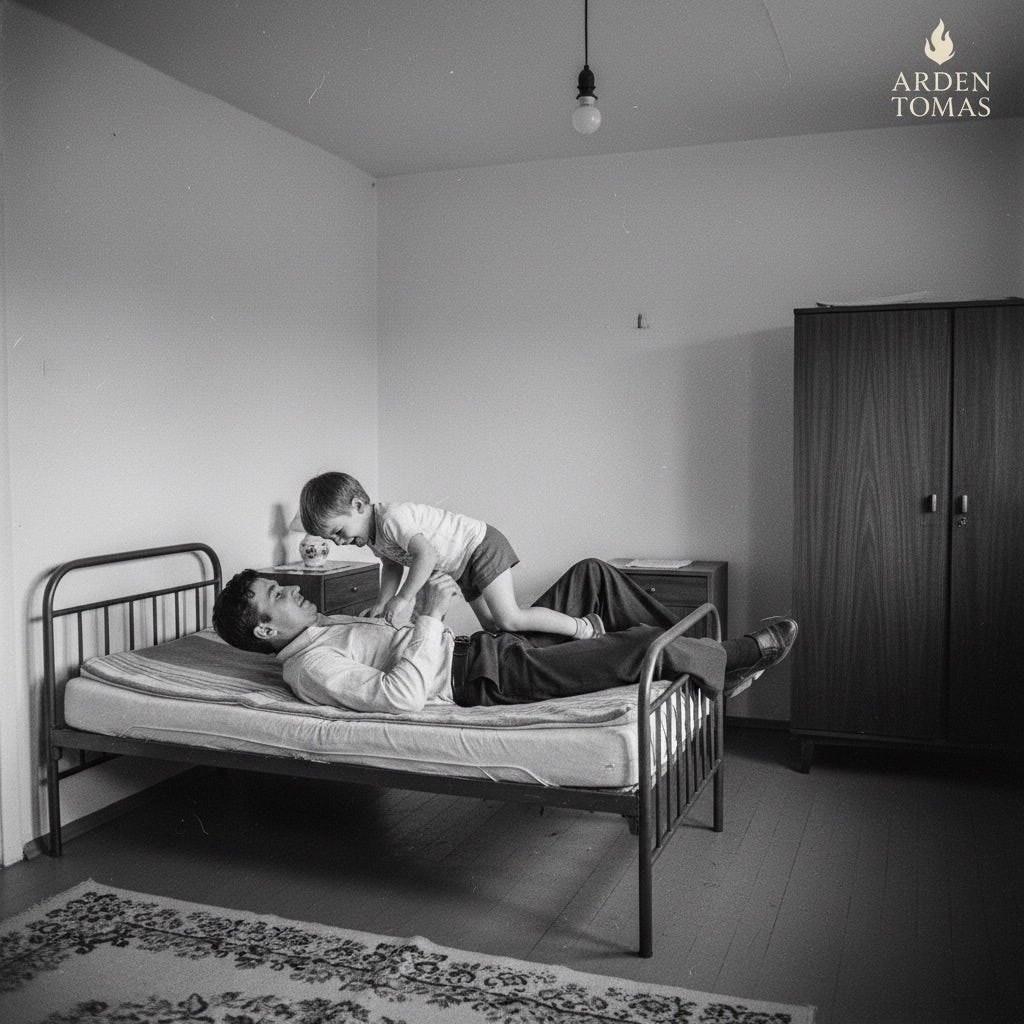
I crawled up next to him. I wanted to play. To connect. He did not know how to play with me properly. He did not tell stories or build things with me. He only tickled me. I was ticklish, and I laughed. I enjoyed it. It felt good that, at least now, he was paying attention to me.
My mother watched with a smile. She was glad that he was finally spending time with me. She was cooking on the wood burning stove. The smell of food filled the kitchen. The fire cracked softly. From the outside, it looked like an ordinary moment of family life.
My father had already had several beers. I wanted the game to continue. I clung to his neck, asking again and again for more. I was laughing when I begged. He eventually grew tired of it.
He sat down on the bed and positioned himself over my head. At first, it did not hurt. In a strange way, I even thought it was part of the game. Then the air began to run out. I started to struggle. I screamed. I tried to move, but I could not.
He did not move. I heard him laugh. I heard him say, “Are you still going to bother me now?” He stayed where he was. My body panicked before my mind could form any thought.
My mother thought I was enjoying myself. That it was still play. From the outside, it probably looked harmless. Inside my body, it was not.
Later, my mother told me that when I was born, I was born lifeless. The umbilical cord had been wrapped around my neck. They had to resuscitate me. My entire body was dark blue.
Perhaps that is why the feeling of having no air left burned itself so deeply into me. Perhaps my body remembered it before my mind ever could.
Section 3
My mother’s mother was entirely different. She was my real grandmother. The one who meant warmth, safety, and calm. With her, there was never any question of whether I was welcome.
She helped my mother a great deal. Not with many words, but by being present. She lived in another house with my mother’s younger brother, my godfather. She was divorced from my grandfather and lived separately, which was uncommon at the time. Still, she made it work. She carried her life with quiet strength.
She never arrived empty handed. There was always something with her. Food. A small gift. Attention. What mattered was not what she brought, but that she came thinking of me. That she was genuinely happy to see me.
My godfather spent a lot of time with me. He played with me. He taught me. Not lessons in the strict sense, but moments. The kinds of things one can do with a three year old child. With him, I did not have to be quiet. I did not have to be careful. I was allowed to be a child.
My grandfather was a bricklayer. It was his work crew that built our family house. When I thought about this later in life, it took on an unexpected weight. The walls that would one day surround us were shaped by his hands. It was as if the family was still trying to build a future, even while the present was already strained.
This period of my life existed in two parallel worlds. On one side, coldness and rejection. On the other, my grandmother and my godfather, and the kind of attention that keeps a child alive. Even then, I began to understand that safety is not automatic. That sometimes it has to be found.
Perhaps that is why I clung to them so strongly. They were the counterweight. The first proof that the world was not only what it felt like in my great grandmother’s house.
Section 4
One morning I woke up and my mother helped me get dressed. I knew what that meant. We were going somewhere. That usually made me happy.
She placed me into the child seat on the bicycle. I was cheerful, curious. I kept asking where we were going. She smiled and said we were going shopping. That calmed me. I loved going shopping with my mother. I always got a small chocolate and a small bottle of cola. I never asked for more. That was enough for me.
The bicycle creaked softly as we rode. I sat quietly in the seat, watching the street pass by. Houses were being built everywhere. Later I learned people called them “kádár cubes,” identical homes designed by the state. At the time, I only saw walls rising, all alike, as if life itself came in one approved shape.
At one point my mother stopped in front of a large building I did not recognize. Many people were going in and out. She took my hand and led me inside.
I asked where we were. She said we were going to the doctor. Fear rose instantly in my chest. I told her I was not sick. My voice trembled. I felt tears coming. She did not explain why we were there.
The hallway was long, cold, and tiled in white. People sat along the walls in silence. I remember this fear clearly even now. I felt it before anything happened. A certainty that something bad was about to be done to me. I asked my mother again and again, but she said nothing.
At the end of the hallway, she knocked on a door. A nurse opened it. She smiled and greeted my mother by name. She asked, “Erzsike, did you bring Tomi?” My mother smiled back, but I could see the worry on her face.
The nurse noticed it and tried to reassure her. She said it would only be a routine procedure. She said it lightly, as if it were nothing. My mother worked in healthcare. This nurse had been her classmate in secondary school.
I did not know what the word “procedure” meant. I only knew it felt wrong.
Inside the room, a doctor was already waiting.
The room felt hostile. Green painted walls. Cold white tiles. The doctor spoke kindly to me. He asked if I had arrived. I nodded and felt myself on the edge of crying.
He said that if I behaved well and did not cry, I would get something afterward.
My mother lifted me onto the examination bed. It was covered with cold plastic. She undressed me completely. Told me to lie on my back. By then I was crying. I was terrified.
The nurse held my legs down. My mother held my hands. I tensed my body. I could not move. The bright lamp above the bed blinded me.
The doctor came closer, wearing a mask. He held scissors in his hand. I felt them touch my penis. I began screaming. The pain was sharp, but the fear was worse. My mother spoke to me, trying to comfort me, but she could not stop what was happening.

When it was over, the doctor said we were finished. He gave me a lollipop.
I was still crying. It hurt. It hurt badly.
This was my circumcision, performed because of phimosis.
Later, my mother told me that when I was born, I had been born lifeless. The umbilical cord had been wrapped around my neck. They had to revive me. My entire body was dark blue at birth.
Perhaps that is why the memory of being unable to breathe stayed with me so clearly. Perhaps my body remembered what my mind could not yet understand.