
 Log in

The Childhood That Was Taken Chapter ll
Scene One
My grandmother’s house
At my grandmother’s, silence wasn’t emptiness. It was a blanket.
In the kitchen, something was always happening. Water boiling. A lid clinking. A patch of fog blooming on the window from the cold. The air smelled like soup, and something sweet and floury that lingered even when the oven was already empty.
I sat on the floor in the other room with my teddy bear. I didn’t build things. I didn’t stack blocks. I talked to my bear. Sometimes I just stared at the pattern in the rug, and it calmed me down that nothing was rushing me.
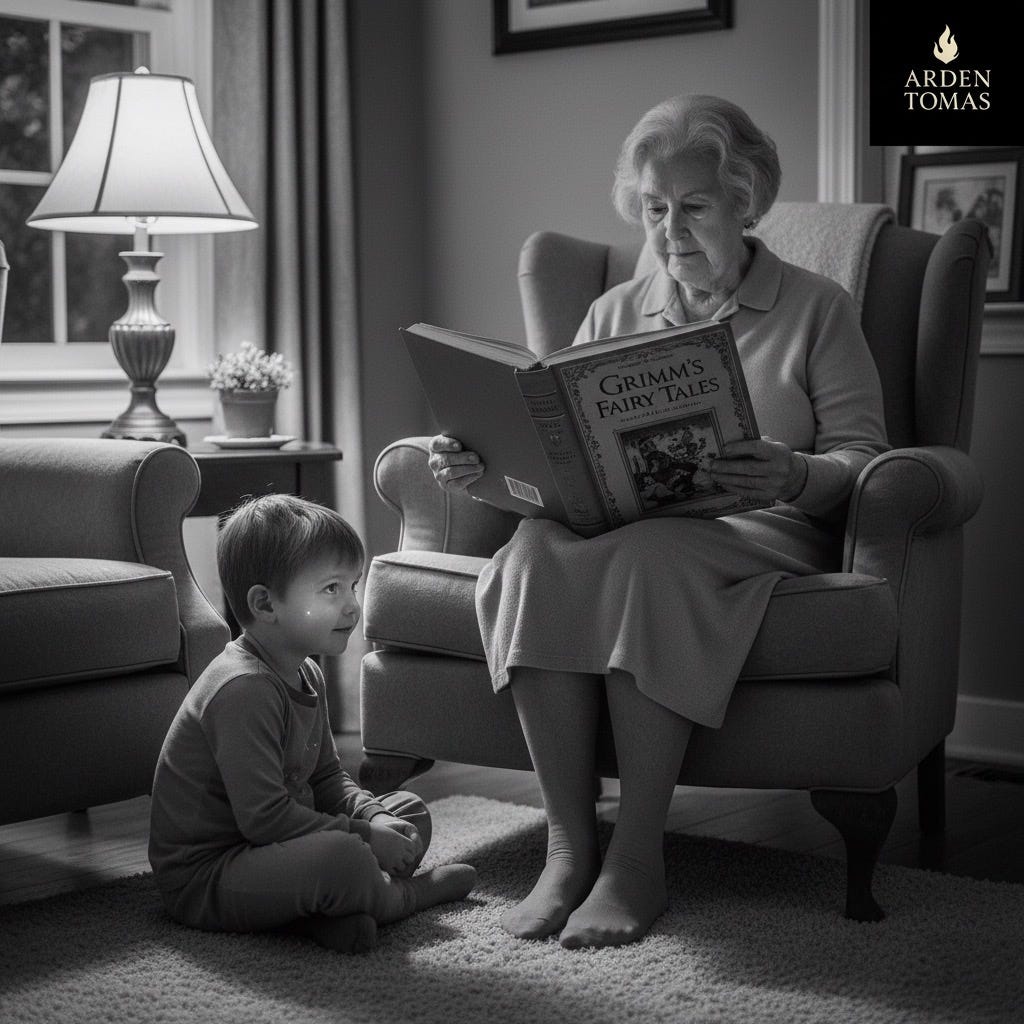
Grandma took out the Grimm fairy tale book.
The book was heavy, thick, the pages yellowed, and when it opened it sounded like the paper itself remembered. Grandma sat down, and I crawled up to her knees, my head almost touching her apron.
She began to read.
There was no mercy in those stories. There were forests, darkness, and people who didn’t ask, they just did. Strangely, it didn’t scare me. It steadied me. Because what was bad stayed bad. It didn’t happen with a smile. It didn’t disguise itself as kindness. At least you could tell where the line was.
And Grandma’s voice was slow. The kind of voice you use when you truly believe someone is listening.
And I was.
Later my godfather arrived.
He didn’t say much as he came in. He just smiled, and the way he hung up his coat somehow made the whole house feel lighter. He sat down on the floor beside me. Not like he was the adult and I was the child, but like we were simply in the same place.
What do you want to play, Tomi?
His voice was deep and calm. There was no impatience in it. No hurry.
We played. Sometimes we raced to find something in the room. Sometimes we just fooled around, and I laughed so hard my stomach hurt.
And then came bath time.
The tiles in the bathroom were cold, the water was warm, and in the steam every sharp corner blurred. My godfather stood there beside me, and it felt natural that we were together. There was nothing forbidden in it, nothing strange. Just that he was strong and I was small, and it felt good to be safe next to him.
I watched how he moved. How his body occupied space. He was muscular, hairy, a real man. As a child I didn’t want anything complicated. I just felt that I wanted to be like him. That certain. That steady.
I looked forward to that moment many times.
I couldn’t have explained why. Only that it felt good. That in that steamy bathroom, for a little while, I had a place in the world.
Then it ended, we got dressed, and the day continued.
Grandma picked up the book again, and I crawled back to her.
In the Grimm stories, someone always got lost, but somehow kept going.
Back then I didn’t yet know that I was learning to do the same.
Scene Two
When my sister was born and I stepped back
The sounds in the house started behaving differently.
Not just quieter. More cautious. Like the adults didn’t simply want silence, they wanted to avoid trouble. From the kitchen came the clink of metal, a pot, a spoon, a lid. Someone moved between rooms, a slipper sole brushing the floor. The air smelled like boiled laundry mixed with that familiar, slightly sweet scent that clung to my mother when she was exhausted.
I was already dressed. Too early. Even my shoes were on. That always meant something was happening that I didn’t control.
My mother looked at me, but not the way she usually did. Not with that full, turned toward you gaze that makes a child feel like he’s the center of the world. It was quick. A check. As if she was counting, making sure everything was still there.
Tomi, stay here, okay.
I’ll be right back.
Her voice was gentle. Just hurried. And hurry didn’t mean she had errands. Hurry meant I wasn’t the errand.
I didn’t understand why.
I stood near the door, staring at the coats on the rack. Mine was the smallest, hanging at the very bottom. The adults’ coats hung above me like a dense forest. Between them there was always a cold smell, as if the outside air had been left inside.
Then I heard the crying.
Not mine. Not my sister’s either, because I didn’t yet know it was her. Just a sound that didn’t resemble anything I’d known. Thin, raw, and still so powerful it changed the whole house.
My mother rushed past me.
In her arms was a small bundle. A white blanket. The edge of it was folded back, and at the center of the bundle, a tiny face. Red. Wrinkled. Mouth open as if it were shouting, but the sound stayed crying, not words.
My mother looked at the bundle, not at me. Not because she didn’t love me. I could see on her face that she loved me deeply. She just couldn’t split her gaze.
Hi, sweetheart, she whispered to the bundle.
And I stood there feeling that something had happened that no one had warned me about.
No one asked me.
No one asked if I wanted this. No one asked if I was afraid. No one asked if I understood. It just happened.
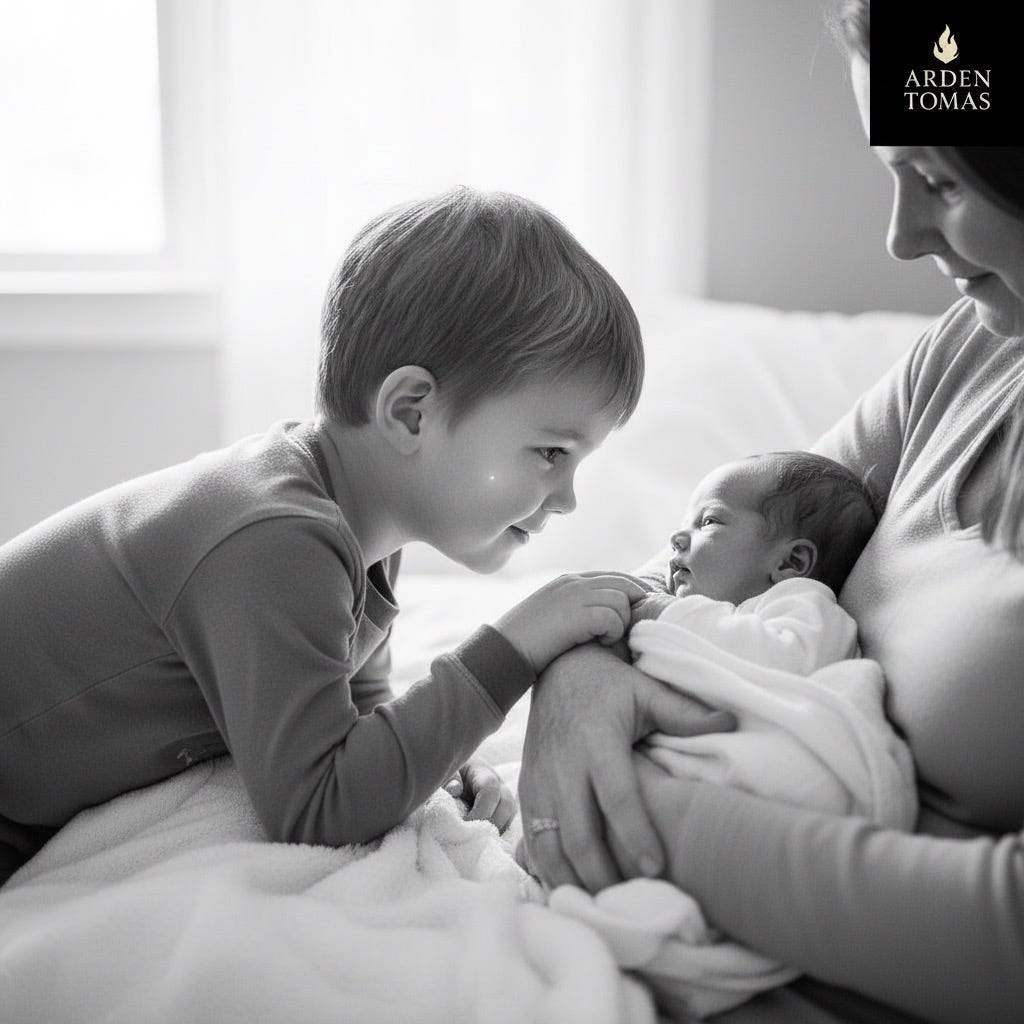
My sister.
I didn’t have a word in my head for it yet. I only had her sound. Her presence. The way the house suddenly held more people, even though it was the same number as yesterday.
My mother sat on the edge of the bed. She adjusted the bundle carefully. Her face was tight, sweat shining at her temple. She was tired. A kind of tired I’d never seen on her before.
Come here, Tomi, she said.
I went closer. I always went closer when someone called me, because I thought that meant I mattered.
My sister kept crying. The sound hit my chest. It wasn’t pain, exactly. More like an internal jolt. My body already understood that this demanded attention.
Do you want to see her, my mother asked.
I nodded.
She lifted the blanket edge. My sister’s face was tiny. Her eyes closed. Her hand twitched for a second, and her finger was so small I couldn’t believe a finger could have its own whole world.
I was happy. Yes. Because my mother smiled. Because it seemed like something beautiful. Because everyone said this was good.
But in that same moment I felt something else.
As if my place, the one that had always felt automatic, was suddenly not marked anymore.
My sister cried on. My mother rocked her. Her movements were automatic, like her body knew what to do and her mind had no space left.
I stood at her knees and waited.
I waited for her to look at me. I waited for her to stroke my hair. I waited for her to say something that was mine.
My mother finally looked at me, but again only quickly.
Tomi, be a big boy for me now, okay.
Her voice was gentle. But the sentence felt like a door closing. Not slammed. Just certain.
Big boy.
I didn’t want to be a big boy. I wanted my mother to hold me the way she did yesterday. I wanted her to be mine for a moment the way she used to be. But I didn’t ask. I didn’t dare. Because the crying was there. The bundle was there. The exhaustion on her face.
And something inside me said that if I asked now, I’d be making trouble.
So I stepped back.
Not dramatically. Not in a sulk. Not in a way anyone would notice. Just half a step. Then another. Until I wasn’t in the way anymore.
In the corner was my little chair. I sat down. My shoes were still on. They squeezed my feet, but I didn’t say anything.
I stayed quiet.
My sister cried. My mother rocked her. The house breathed around us. The sounds stayed cautious. Adults whispered in the kitchen. Don’t wake her. Don’t disturb her. She’s sleeping. She’s eating. She hurts.
Every sentence was about her.
I didn’t blame her. Never. I only felt that suddenly I wasn’t urgent. As if my presence was taken for granted. As if it was enough that I was in the corner.
The strangest part was that no one called this a change. No one told me what to do with it. No one asked how it felt.
No one asked me.
And with three year old skin and no six year old logic, I only understood one thing. If there’s no question, there’s no answer required.
I disappeared.
Not physically. I was there. In the corner. In my shoes. On my little chair.
But inside, I took one step back.
And later, that step repeated itself many times.
Scene Three
The night of folk songs
At my grandmother’s, the celebration always began before I could even understand it.
You could feel it in the air by afternoon that today would be different. The kitchen was full of smells. Roasted meat, onions, something sweet and doughy, oil and spices I couldn’t name, only that the air felt heavy from them. Grandma moved between the stove and the table like she couldn’t stop, because if she stopped, the day would collapse.
My mother helped too. Quieter. Tighter. Not like when we went shopping and she smiled. Here she watched everything. Her movements were fast and precise, like she was trying to avoid something.
They put me on a chair and told me to be good.
I was good.
Not because I was heroic, but because I was used to it. If I’m good, there’s less trouble. If I’m good, I’m noticed less. If I’m good, nobody expects explanations.
The guests arrived. Shoes on the rug. Coats on the rack. Voices. Laughter. Greetings. Adults always sounded a little different when they were celebrating. Higher. Looser. The discipline slid off them. And as time passed, the drinking became the center of everything.
The men drank.
Not just once. Constantly. Glass clinked against glass, and with every sip their world grew a little bigger, they grew a little louder, a little braver.
Then my grandfather took out his instrument.
The accordion cut into the room like someone had opened a door we’d been afraid to look through. The sound was beautiful and suffocating at the same time. It crawled into your chest and didn’t want to leave.
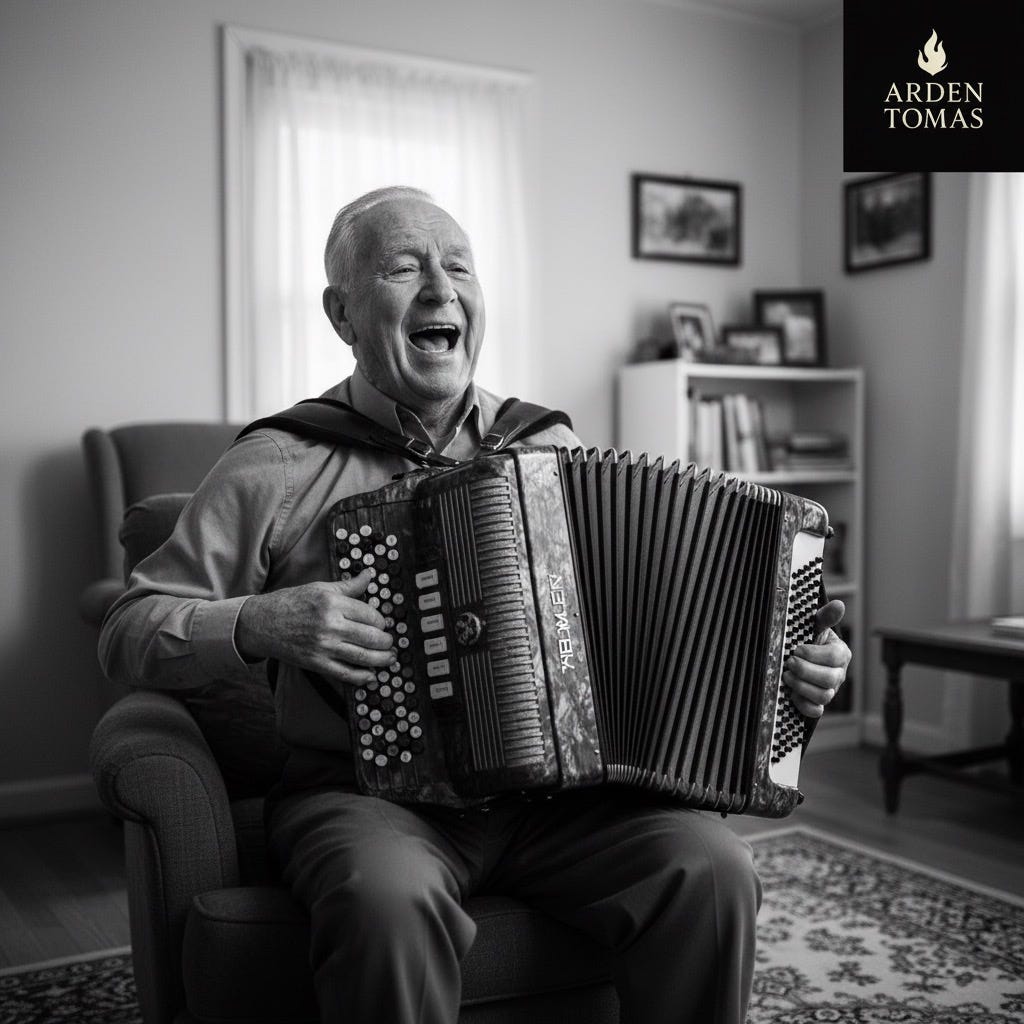
My grandfather began to sing.
Hungarian folk songs. Long ones. Drawn out ones. The kind where after the first line you already know this won’t end quickly. The men laughed, clapped, stamped the rhythm, like this was their celebration and the house was just a stage.
I sat on the chair.
At first something tightened inside me. I didn’t know why. I didn’t have thoughts for it. My body just reacted. Like the sound came too close. Like it wasn’t speaking to my ears, but pressing from the inside.
Then I started to cry.
I didn’t want to. I didn’t decide to. It just came out.
At first quietly. Then louder and louder, because I couldn’t stop it. As if the songs and the laughter kneaded together everything I had been holding silent, and now it had to break out.
Grandma looked at me.
My mother looked at me too.
For a moment I thought someone would come over, take me into another room, hold me, and say it’s okay, you’re just tired.
But my grandfather looked at me first. Really looked.
His gaze shifted fast. Like he’d been living inside the song and something yanked him back. There was no curiosity in his eyes. No understanding. Only that I was bothering him.
Like a wrong note in the music.
He stood up.
The chair creaked under him, and when he started toward me, I already knew. I don’t know how, I just knew. My crying got louder, because my body was afraid before my mind could even catch up.
He grabbed me.
His hand was big, strong. He didn’t hit me. He didn’t shout. He just took hold, and with a movement that didn’t ask and didn’t negotiate, he dragged me into the room.
The sounds stayed behind us for a second, then the door shut, and you could still hear everything, only more muffled.
The accordion didn’t stop.
The song kept going.
So did the laughter.
As if I didn’t exist.
I stood in that room and cried. I couldn’t stop. My chest jerked, my throat burned, my eyes stung. I didn’t understand what I’d done wrong. I only felt that now I wasn’t just crying, I was ashamed of crying.
My grandfather stood in front of me.
He didn’t say much. He didn’t need to. His presence was enough. His silence didn’t calm me. It punished me.
Then he left.
He stayed out there with the others. He went back to the song like nothing had happened.
I stayed in that room alone, with the muffled sounds.
The accordion came through the wall.
Every note felt like a small knife.
Grandma came later. Slowly. With movements like she was afraid that if she moved too fast, something would break even more. She sat next to me, stroked my head, tried to comfort me.
I heard my mother’s voice from the other room.
I didn’t see them, but I heard her arguing with her father. Her voice was sharp. Protective. A kind of mother voice you don’t hear often. She told him he could never do that to me again. That he couldn’t treat me like that.
I felt the hand on my head, and at the same time I felt that outside, the world went on exactly the same.
The song kept going.
The celebration kept going.
And somehow what I learned was that if I’m too loud, if I’m too much, they set me aside.
They don’t ask me.
They set me aside.
That night I also heard my mother and father talking. I didn’t understand every word, but I understood my father’s tone. Indifferent. Like it was all just an unpleasant episode.
He just said my grandfather was crazy when he drank.
And that closed it.
No one asked me why I cried.
No one asked what hurt in those sounds.
I only learned that sometimes my body tells the truth before the world can tolerate it.
And even then, I already knew what to do.
I stepped back.
I stayed quiet.
Scene Four
The fight and the divorce
In the children’s room, even the dark had a sound.
Not because I was afraid of the dark, but because the wall was too thin. Voices seeped through. At first only muffled, like a drawer closing. Then sharper, as the sentences no longer fit inside adult mouths.
I was six. My sister was three.
She lay beside me, twisting the edge of the blanket between her fingers. She didn’t understand what was happening, only that something was wrong. I didn’t understand everything either, but the voices taught me what I needed to know.
My mother was crying.
My father’s voice was hard. He wasn’t shouting at first. It was colder than that. The kind of cold that doesn’t sound like an argument to a child, but like something has broken for good.
Then my mother said it.
You cheated on me.
The words hit the air like something shattering in the kitchen, and everyone freezes for a second because they know it can’t be put back the way it was.
My mother yelled, then cried again. Her voice was desperate, not pretty, not controlled, the kind that makes you feel this isn’t just a fight anymore.
My father wanted to leave.
They didn’t say it in those exact words. You could hear it underneath the sentences. In the pauses. In the air. In the moment my mother stopped pleading and started screaming instead.
And then it happened, the part I still remember.
A dull sound. A movement. My mother hit my father. I don’t see it, I only hear it, and I feel my whole body flinch.
My father hit back.
My mother fell to the floor.
I ran out.
I didn’t think. I just moved, because my mother’s voice sounded like the ground had disappeared beneath her.
My father shoved me aside.
It wasn’t a dramatic gesture. It wasn’t a performance. That was what made it worse. One single movement that said I didn’t matter right now. That I was in the way. That I should go back where I’d been.
My sister cried behind me. I cried too.
My mother screamed at him not to hurt me.
My father stormed out of the house.
When the door slammed, it wasn’t silence that followed. It was a different kind of sound. My mother’s sobbing, and the air that tells you this is not going to return to normal.
Later the word divorce appeared.
Not because anyone explained it. Not because they sat us down. No one asked us. It just happened. Papers. Strange adults. Tense afternoons.
In the end, my father took us every other weekend.
It sounds like a program when you say it like that. But there was no program in it. It was obligation, like a jacket you have to put on because that’s what people do, even though you don’t feel like yourself in it.
His new girlfriend tolerated us.
She cooked and baked, but her hands moved as if her mind was somewhere else. The food smelled like food, but the warmth wasn’t there. My father watched TV. We played with the neighbor kids, or stared at the screen, waiting for time to pass.
On the way home, I always felt relief, and then shame for feeling it.
Because a child isn’t supposed to feel relief when he leaves his father’s house.
But by then I had already learned to do a lot of things without being asked.
Scene Five
The dreams
I don’t remember exactly when they began.
There wasn’t a first day. No date. No sign that tonight would be different. They were simply there one night, then again, and eventually they stayed inside me like an image you can’t rub out from behind your eyes.
In the dream it always started the same way.
There was no lead in. No path to it. I was just there.
Naked.
Not naked in the way shame makes you naked, but naked the way a child doesn’t yet know what he’s supposed to cover. I wasn’t embarrassed. I wasn’t afraid. There was only a strange, clean awareness that this was how it was.
And then my body wasn’t on the ground.
I was hanging upside down.
By my legs. As if someone had lifted me and was holding me there. I didn’t see hands. I didn’t see a face. I didn’t see a person. I only knew I was hanging.
Like a plucked chicken waiting to be processed.
The image was too specific to be just a child’s dream, and yet it was a child’s dream. There was no blood. No knife. No threat. Nothing that wanted to hurt me.
Only this position.
The weight of my body pulled into my legs.
The blood drawing toward my head.
That strange floating feeling in my stomach that makes you feel light and helpless at the same time.
I wasn’t afraid.
That was the strangest part.
I knew it was strange. I knew it wasn’t normal. But I wasn’t afraid.
I was watching.
As if the dream didn’t want to scare me, only to show me something. As if it was saying, look at what it feels like when you aren’t in control. When there’s no ground under you. When you can’t leave. When you can’t turn away.
And still, somehow, it wasn’t bad.
Not unpleasant.
Not painful.
Only unfamiliar.
Sometimes in the dream I tried to move, but my body acted as if it had no business doing that. As if it accepted that this was the way things were. As if movement didn’t matter.
And I hung there, and my thoughts didn’t attach to anything.
There was no question.
No explanation.
Only my body.
Only the position.
And the silence.
When I woke up, I didn’t run to my mother. I didn’t cry. I didn’t call for anyone. I just lay in bed staring into the dark of my room, as if I needed to check that the ceiling was still where it belonged. The blanket was over me. My teddy bear was beside me. Everything looked the way it always did.
Only I was different.
The dream didn’t leave terror behind. It left a strange mark.
As if my body had sent a message.
As if it knew something before I could understand it.
In the morning I didn’t talk about it.
Not because it was a secret.
Because I didn’t have words for it.
A child doesn’t say he dreamed about being powerless. A child doesn’t say his body is processing something in its own language. A child doesn’t say there was floating, and a strange kind of calm.
He only knows something happened to him.
And he also knows no one is asking.
No one asked me.
Just like no one had asked me about so many things before. Not when I stepped back after my sister was born. Not when the folk songs choked me from the inside. Not when my grandfather dragged me into the room. Not when my father stayed indifferent.
It was the absence of questions that shaped me most.
And slowly I learned that if there’s no question, there’s no answer either.
But my body answered for me.
At night.
With dreams.
With images.
With feelings that weren’t unpleasant, only strangely familiar, as if they were saying, one day you’ll understand.
I didn’t understand yet.
I only knew there was a place in the world where I didn’t have to speak.
Where I didn’t have to explain.
Where I didn’t have to be a good child.
In the dream I was simply hanging upside down, and something inside me watched in silence.
Not with fear.
With patience.
As if it was waiting.